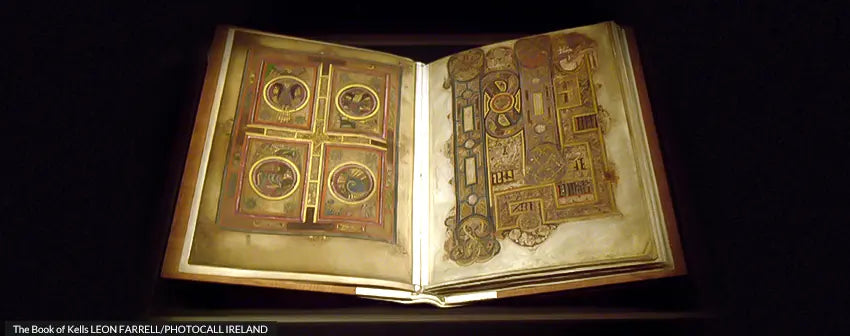

It’s no secret that the Book of Kells is one of the most beautifully ornate, visually striking, and remarkable historical documents in existence today. This illuminated manuscript, currently housed in Trinity College in Dublin, is perhaps the most iconic and globally renowned representations of Celtic Art.
In this article we are going to explore the content and the legacy behind the famed Book of Kells.
What is the Book of Kells?

For those who might be unfamiliar with the Book of Kells, it is essentially a uniquely artistic representation of the New Testament of the Bible. The Book of Kells uses the distinct styles of Celtic art and Irish art incorporating knotwork patterns, heavy usage of brown, yellow, and green colour, and very sharp and angular runic styles of font.
Over the course of its 1200-year existence, the Book of Kells has grown to become much more than an artistic manuscript. It is now seen as a national symbol and has become synonymous with Irish culture and Celtic artistic expression and representation.
When was the Book of Kells Created?

As mentioned above, the Book of Kells has been in existence for approximately 1200 years. However, the exact history and origin of the Book of Kells is a matter of great controversy and confusion to historians and art history experts to this very day.
The most popular and widely believed theories are that the book was either created in Kells, a small island located between Ireland and Scotland called Iona, or that it first came from a church in Northumberland.
While there is some debate as to which of these three locations the Book of Kells originates from, the ornate illustrations and undoubtedly Celtic calligraphy trace the manuscript to its Gaelic heritage.
It is thought that the Columban monks from Iona who were responsible for creating the Book of Kells, brought the book with them when they relocated to Kells in the early 9th century. The book then remained in Kells for centuries until around 1653, when it was moved to Dublin for safe keeping.
In 1661, just eight years later, the Book of Kells was given to Trinity College Library, and has been on display in Trinity College to the public since the mid-19th century.
The Beauty of the Book of Kells

We’ve already discussed how the Book of Kells is fundamentally an artistic representation of the New Testament. The beauty of this book is how it marries the stories and fables of the New Testament with the unique style of Celtic art.
The pages of the book, commonly referred to as folios, are made from the skin of calves. This material is known as vellum. It’s believed that it took the skin of more than 185 calves to create the Book of Kells.
The colours used in the Book of Kells are varied and vibrant to say the least. Different shades were produced by mixing ink with copper pigments, natural minerals, and even fruit such as elderberries and blueberries. The result is an energetic and animated artistic manuscript with a wide and well utilised pallet of colour.
The Book of Kells is a priceless treasure and a central pillar in the pantheon of Irish and Celtic artwork. Should you ever find yourself in Dublin, a trip to Trinity College is made all the more memorable and wonderful by getting a first-hand glance at Celtic art’s defining moment.
Shopping for someone special?
Every Sheodra gift is thoughtfully prepared so it feels personal the moment it is opened.
- Handwritten card
- Free engraving
- Heritage gift box
- Direct-to-recipient